Sthira Sukham Asanam: What Patanjali Means by Steady and Easy
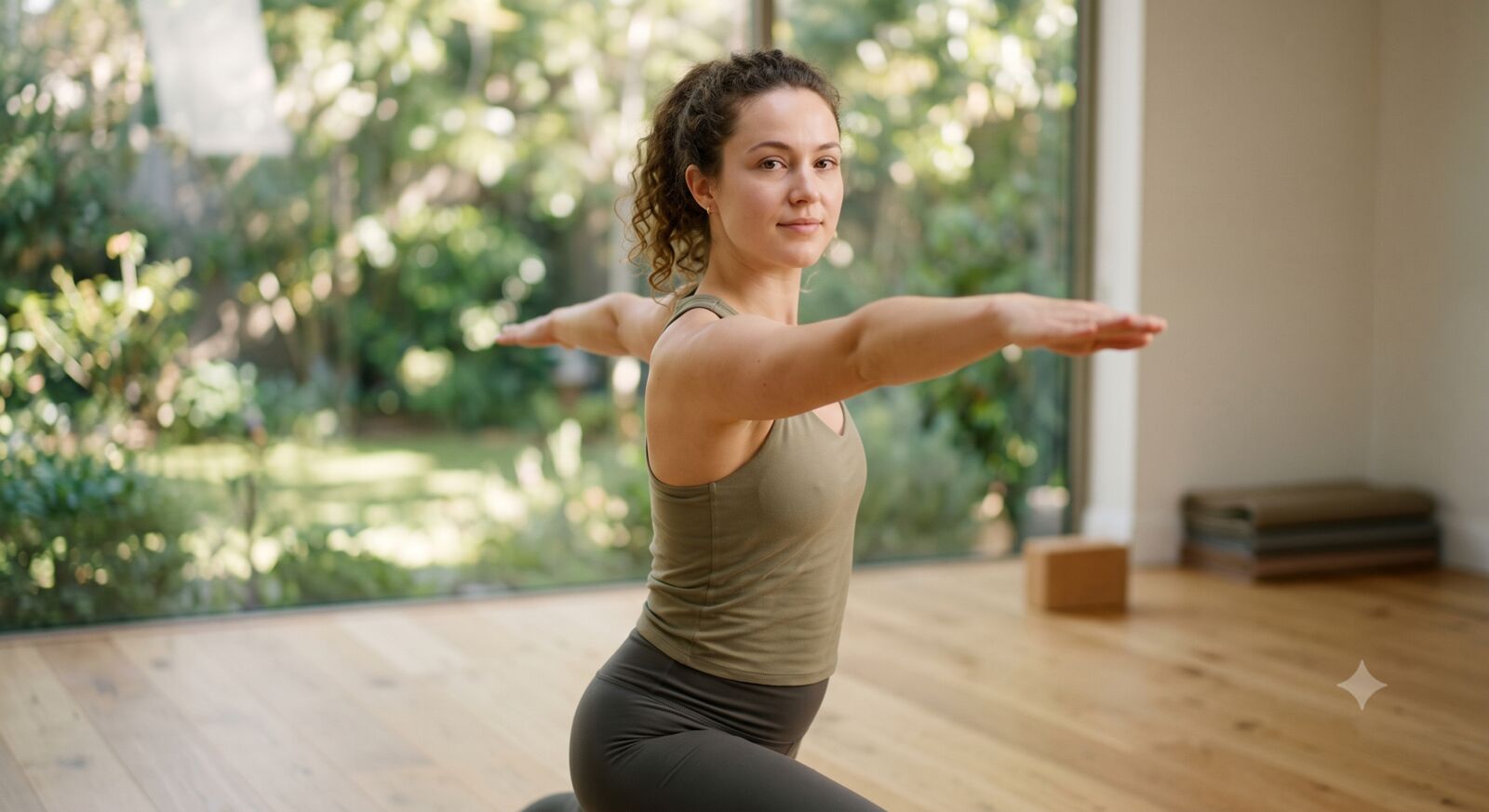
Sthira sukham asanam (Yoga Sutra 2.46) means a yoga posture should be steady (sthira) and comfortable (sukha). Patanjali gives one test for any pose: can you stay in it without strain and without collapsing? The next two sutras add how: relax effort and let attention settle.
The Yoga Sutras of Patanjali say almost nothing about yoga poses. One short line, Sutra 2.46, gives the only instruction for posture in the whole text: sthira sukham asanam. It is three words long, and it is still one of the most useful rules in yoga.
What sthira sukham asanam means
The phrase has three Sanskrit words:
- Sthira: steady, firm, stable.
- Sukha: ease, comfort, a sense of well-being. The same word is inside sukhasana, "easy pose".
- Asana: literally "seat". In the Sutras it means the way you sit for meditation.
Put together, the line says a posture should be steady and comfortable. Translators choose slightly different English words ("steady and comfortable", "firm and pleasant", "stable and easy"), but the idea is the same: two qualities held together.
Where it appears in the Yoga Sutras
The Yoga Sutras are a collection of about 195 short verses on the practice of yoga, gathered into four chapters. Most scholars date the text to somewhere between about 200 BCE and 400 CE. Sutra 2.46 sits in the second chapter, the Sadhana Pada, which is about practice.
Patanjali describes yoga as eight limbs. Posture is the third:
- Yama: ethical restraints
- Niyama: personal observances
- Asana: posture (the subject of this article)
- Pranayama: breath practices
- Pratyahara: drawing attention inward
- Dharana: concentration
- Dhyana: meditation
- Samadhi: absorption
What Patanjali says next
The next two sutras explain how to get there:
- Sutra 2.47: the posture is perfected by relaxing effort and by resting attention on something limitless, often translated as "the infinite".
- Sutra 2.48: as a result, you are no longer disturbed by the pairs of opposites, such as heat and cold or comfort and discomfort.
In plain terms: stop forcing, let attention become wide and calm, and discomfort stops pushing you around. This is why the rule is about quality, not shape. A pose is not judged by how it looks.
Did Patanjali teach yoga poses?
Not in the way we mean today. The Sutras do not list any postures. Asana there is a seat steady enough for long meditation. Later texts describe physical poses: the Hatha Yoga Pradipika (commonly dated to the 15th century) describes 15, and the Gheranda Samhita (commonly dated to the 17th or 18th century) describes 32. The standing poses, flowing sequences and studio classes most people know today developed mainly in the 20th century, according to yoga historians such as Mark Singleton.
So when we apply Sutra 2.46 to warrior pose or downward dog, we are extending an old principle to modern practice. It is a sensible extension. It is also worth knowing that Patanjali did not have handstands in mind.
A simple check: is this pose steady and easy?
Use these four questions in any pose:
- Breath: can you breathe smoothly through your nose, without holding your breath?
- Face and jaw: are your jaw, tongue and brow soft?
- Structure: is your weight even, with nothing collapsing into a joint?
- Time: could you stay for five more slow breaths without wanting to escape?
If the answer to any of them is no, ease off a little. Reduce the depth, shorten the stance or add support. That is the practice, not a shortcut.
Muscles working, and even shaking a little, is normal. Sharp, pinching or joint pain, numbness or tingling are signals to come out of the pose.
How to apply it to common poses
- Warrior II: shorten the stance until you can breathe easily. Keep the front knee over the ankle. If your shoulders burn, lower your arms a little.
- Downward dog: bend your knees as much as you like and lengthen your spine first. Straight legs come later, if at all.
- Child's pose: put a folded blanket or cushion under your hips or torso so your body can rest.
- Seated meditation: sit on a cushion or folded blanket so your hips are above your knees, or use a chair. Comfort is not cheating here. It is the instruction.
- Mountain pose: keep your knees soft and your weight even across both feet.
Common mistakes
- Chasing depth: going as far as possible before the pose is steady.
- Gripping: clenching the jaw, shoulders or toes to hold on.
- Holding your breath to get through a hard pose.
- Comparing your pose to photos or to the person on the next mat.
- Confusing ease with slack: letting the pose go floppy. Sukha does not mean sloppy, and sthira is half of the rule.
Try this today
Pick one pose you already do. Hold it for five slow breaths and run the four-question check. Adjust until every answer is yes, then notice how much smaller the pose has become and how much calmer it feels. To pair it with breath, try the six-breath opening in Why Every Session Begins with Breath.
Educational content, not medical advice. If you have an injury, are pregnant or have a health condition, check with a qualified teacher or health professional before trying new poses.
Frequently asked questions
What does sthira sukham asanam mean?
It means a yoga posture should be steady (sthira) and comfortable (sukha). It is Sutra 2.46 of the Yoga Sutras of Patanjali.
Which sutra is sthira sukham asanam?
Yoga Sutra 2.46, in the second chapter (the Sadhana Pada), which is about practice.
Does Patanjali describe yoga poses?
No. The Sutras give one instruction about posture, that it should be steady and comfortable, and do not list any poses. Later hatha yoga texts describe physical postures.
How long should I hold a pose?
There is no single rule. The steady-and-easy test decides. Many beginners start with three to five slow breaths and come out earlier if the pose stops feeling steady or comfortable.
Is it okay if a pose feels hard?
Effort is normal. Strain that makes you hold your breath, clench your jaw or feel sharp or joint pain is a sign to ease off or use support.
Sources and further reading
- Edwin F. Bryant, The Yoga Sutras of Patanjali: A New Edition, Translation, and Commentary (North Point Press, 2009)
- B.K.S. Iyengar, Light on the Yoga Sutras of Patanjali (1993)
- Swami Muktibodhananda, Hatha Yoga Pradipika (Bihar School of Yoga, 1985)
- Mark Singleton, Yoga Body: The Origins of Modern Posture Practice (Oxford University Press, 2010)
Sanskrit terms and sutra summaries here are our own plain-language paraphrase. Read the editions above for full translations and commentary.
New articles by email
One new article a week, free. No spam. Unsubscribe anytime.
More in Philosophy
Philosophy · 4 min read
You Are Not Your Mind
Most of us treat every thought and mood as a fact about the world. A chapter on the mind suggests a different test: check it against your own day.
Philosophy · 3 min read
Showing Up Without Keeping Score
The Gita describes yoga as evenness of mind. What that means for streaks, challenges and off days.
Keep reading

Breath & Meditation · 7 min read
How to Create a Meditation Space at Home, Even in a Small Room
A step-by-step guide to setting up a breathing room or corner at home, based on Thich Nhat Hanh's Making Space: where to put it, what to keep in it and how to share it.
Breath & Meditation · 5 min read
Mindful Breathing Exercise: A Step-by-Step Guide Based on Thich Nhat Hanh
How to practise mindful breathing with short silent phrases, how long to do it, and what to do when your mind wanders, based on the breathing chapters of Making Space.

Breath & Meditation · 5 min read
Loving-Kindness (Metta) Meditation for Beginners: A Step-by-Step Guide
How to practise metta meditation in the Plum Village way: start with yourself, then extend kindness to others in a set order, and what to do when it feels forced.